EXPLORER LAMPS – AN INTERVIEW WITH KINCSŐ KÁDÁR – HARGITA NÉPE
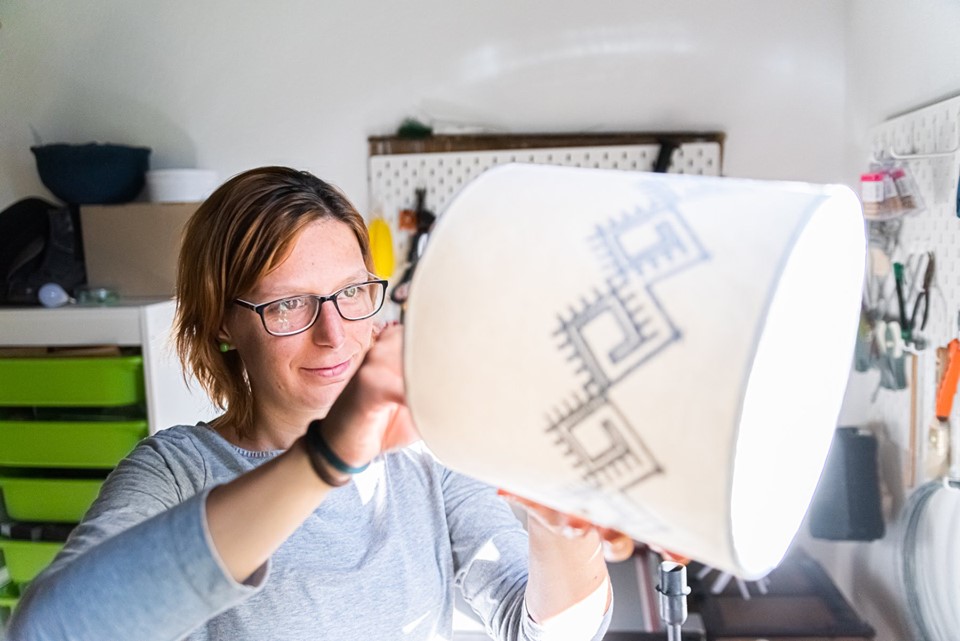
Kincső Kádár’s lamps are bringing light and joy to more and more homes. I call her handcrafted creations “Explorer lamps”, while she uses the English word “Explore”. Both names are fitting, as her lamps bring a special sense of brightness and cheerfulness into a home, whether it is day or night. They dispel the darkness and illuminate the home during the evening hours. At the same time, they invite people to explore and discover the lamps’ hidden motifs, as the patterns concealed by Kincső only reveal themselves when the lamp is switched on.
– Where did the idea of making lamps come from?
– Almost a year ago, I conducted research into the needs of people interested in handcrafted products from Székely Land, as well as their opinions and experiences regarding design and handmade products. The results showed that home décor items – including lamps – ranked third among the most sought-after products. I have always been drawn to various forms of handicraft. I started making things as a child, and craftsmanship has been part of my life ever since. When I decided to start my own business, I wanted to create something that could be both a decorative object and an essential part of a home, and a lamp is exactly that. It can give a room character while also fitting harmoniously into its interior.
Another factor influencing my decision was that we could not find a lamp that would work equally well in a traditional farmhouse and in a modern apartment. I divide my lamps into two groups. The first group consists of lamps made by recycling cardboard waste, so they are made entirely from brown cardboard. These are pendant lamps, for which I use eco-friendly paint. A little glue and varnish are needed to make them, but apart from these, they are made from natural materials. This type of product can be considered both eco-design and handicraft.
More and more people from across Székely Land come to me precisely because recycling waste is important to them, or because they value businesses that regard waste as a raw material. The second group consists of floor lamps and bedside lamps. In these cases, I create layers from translucent paper and conceal a motif within them, so that during the day the lamp has a pleasant, clean white appearance, while in the evening, once it is switched on, the pattern emerges. That is why I call my lamps Explore lamps: you have to discover the patterns. In the case of lamps made from special translucent paper, we could also say that I am recycling patterns. I draw most of my inspiration from folk motifs and traditional Hungarian embroidery.
– What experiences have you had recently? What generally influences customers when choosing a lamp?
– It is very important to me to see the home where the lamp will be placed. If possible, I visit the customer in person and look at the objects, home accessories and furniture they have chosen for their home. If the interior is clean and minimalist, a densely patterned lampshade in an intense colour that complements the space can become the jewel of the room.
If the home is too far away, I usually ask for a photograph, so I can get a glimpse into the person’s home. It is very important to understand the characteristics of the space and the style of the people living there. You have to pay attention to the colour of the walls as well as the size of the room.
Let me give you an example: if a densely patterned lampshade is placed in a narrow hallway, the pattern may be projected onto the walls through the perforations because of the confined space, and this may bother some people. If the same lampshade is placed in a living room, however, the light will be projected through the tiny openings onto the wall in a subtle, almost imperceptible way.
I also need to know what each space is used for and where the residents spend most of their time. If possible, I ask for the floor plan and the lighting plan of the home. Without these, it may happen that the desired lamp is completed only to discover that it ends up in the way of a window or a cupboard door.
In modern homes, it is also common to have separate lighting for the kitchen worktop, the general illumination of the space, and the dining table. In such cases, we can really play with ambient lighting. A warmer bulb can be placed above the dining table, so that after a tiring day, the family can end the day gathered around the table in a pleasant, soothing light. In the same way, we can change the atmosphere of the bedroom, living room or children’s room.
I often have a good laugh when people send me a photograph of the bare bulb hanging from their ceiling with a message saying, “We’ve been looking at this for X months,” and asking me to recommend a beautiful lampshade. The whole process is fascinating – the way people choose the lamp that is right for them. I let them into my workshop when they want to look around, and they let me into their personal space in return.
Ideally, the customer can come to my workshop, because that is where the collaborative design process can begin. They can try out existing pieces, and we can fine-tune the shape, colour and size together. Every lamp purchase is a story of its own.
– Does anyone question the durability of handmade products?
– People who are unfamiliar with handicrafts often associate handmade objects with the idea that they are not as precise as industrially manufactured products. Here in Székely Land, many of us know from the work of our grandparents that, actually, handmade objects can be made with a very high degree of precision and care. My lamps are also very durable. During the experimental phase, there was even a time when I wanted to throw away a lamp because the shaping had gone wrong, but we could barely manage to break it!
– Why does a lamp have such a special role in a home, and why is it special to you personally?
– A distinctive lamp can create a very special atmosphere in a room. The light source is extremely important in a home and can have a significant influence on the emotional atmosphere of a family. With the right lighting, you can create an intimate, cosy and pleasant environment, and this can be achieved differently in every home and every room.
A lamp is both a decorative object and a functional piece: during the day it may not have a particularly important role, but in the evening it becomes a useful part of the interior. I spend a great deal of time working on each lamp, and sometimes I become attached to them and give them names.
When it comes to pieces that are not made to order, I imagine what their new home will be like, who will talk, eat or read under their light. I give these lamps names too, because their atmosphere often inspires me, and secretly I really hope that they will bring someone just as much joy as they brought me.
I often play with the idea of what the future owner or recipient will be like, in addition to how the lamp will fit into their home, and sometimes I get it exactly right. For example, if a lovely lady comes into the workshop and looks at eight different bedside lamps, I already know which pattern she is going to choose.
There was a period when I changed the lampshade in our own home every week because I could hardly wait to see how well a particular lamp would feel in the space. These lamps have souls.
Kincső Kádár studied cultural anthropology and ethnography in Cluj-Napoca and completed a master’s degree in PR at Sapientia University in Miercurea Ciuc. She worked as a museum educator, leading activities for children, and handicrafts have always been part of her life. She lives in Sântimbru with her husband, and her workshop is located in their home, a renovated traditional farmhouse. She creates lamps from recycled materials, viewing waste as a raw material, and considers it important not only to give waste a new life, but also to preserve and give new life to traditional folk motifs.
Published in Hargita Népe
- August 25, 10:29
Author: Ágnes Péter
The original version of the article can be found here.