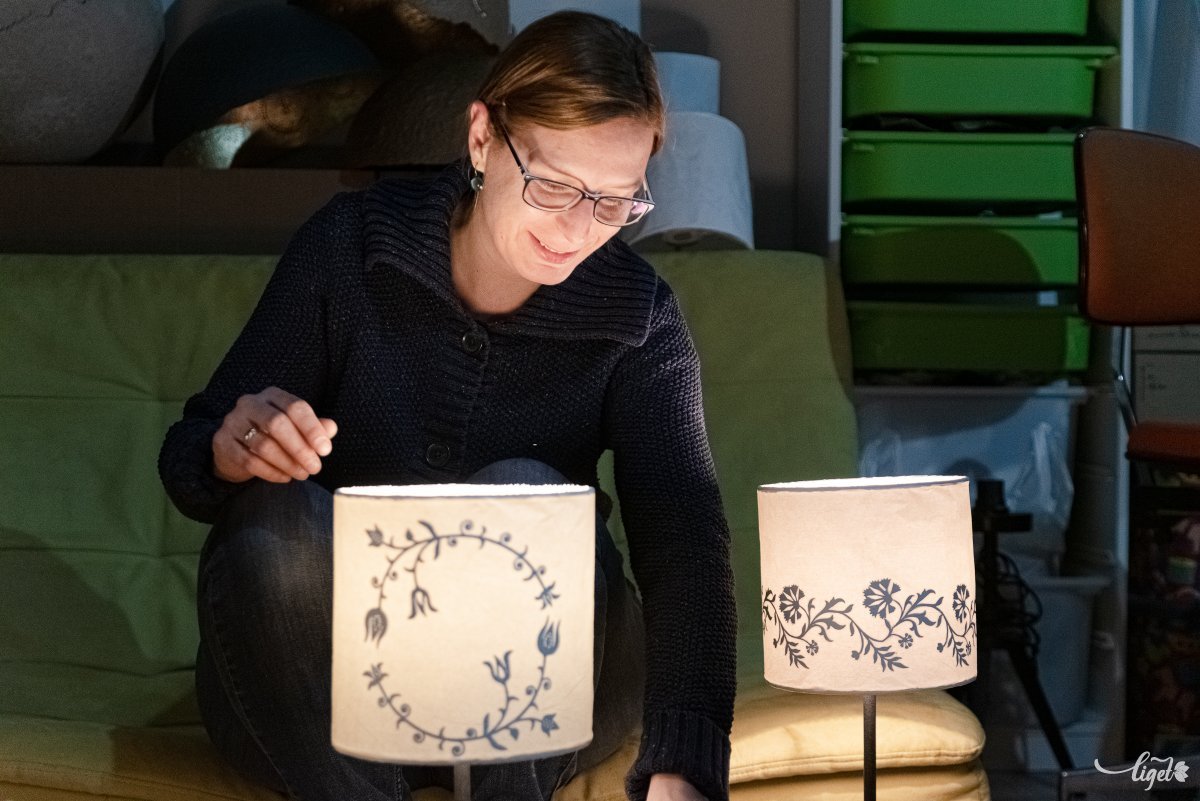
Machines, tools, various materials, a lathe inherited from her husband’s family, and a beautifully arranged space for creativity. Beautiful handmade lamps line the walls and hang from the ceiling: this is the workshop of Kincső Kádár, located in the centre of Csíkszépvíz, in a renovated traditional farmhouse. These lamps are special not only because of their shapes and the way they are made, but also because their creation was preceded by scientific research.


She studied ethnography and cultural anthropology, and as a museum educator and leader of children’s activities, she has always sparked children’s imagination with creative games and tasks of her own invention, experimenting with handmade objects for themed children’s programmes. She has been running her own business for ten years, creating various handmade and design objects. The newest branch of her work now occupies her everyday life: lamp making.
Conscious design Kincső Kádár has been crafting since childhood. The long summers spent with her grandparents, the freedom of the rural environment when it came to tinkering, and the sewing, knitting, crocheting and embroidery she learned from her grandmothers all contributed to setting her on the path of craftsmanship. “When I was in high school, I started organising summer camps. I was usually the camp leader responsible for crafts, and my teacher-training studies also contributed, as handicrafts were a core subject. Later, as a museum educator and during the Discovery workshops I led, I enjoyed combining different branches of crafts,” she recalls.
Her work with lamps is the result of conscious planning, developed over several years. She first completed a course in advertising graphics, followed by a Master’s degree in Public Relations at the Csíkszereda Faculty of Sapientia University. According to her, the teachers there were an enormous help, providing her with advice and professional guidance week after week. “This is how I arrived at the point where I could clarify for myself which of the many crafts I was familiar with I wanted to focus on most. My teachers also encouraged me to base this decision on research. That is why I call these lamps ‘scientific lamps’. We never expected it to become a representative survey, yet more than 540 people completed the questionnaire.
I asked the community for help through a dialogue: What kind of handmade products are needed? What is missing in Székely Land and Transylvania? What should a handmade product meet the requirements of today? In response to the survey, I offered these lamps.” As she explains, people who work with or are interested in handmade products often encounter terms such as handmade, handcraft, craft, folk, design product, and so on. Her research also explored these concepts, clarifying what each one actually means and where it originated. “I began to research these terms from a historical perspective as well: what developed from what, and which direction could serve as a guide for me. At the same time, I became interested in what rules govern each of these terms, and whether they have any official legal definition or regulations. I started to unravel all of this, not only out of personal interest, but also because I wanted to provide some guidance for people who want to make a living from their craft and are just starting a business: what should they pay attention to? It is also useful to clarify what qualifies as a handmade product. At fairs, I see products marketed as handmade or folk handicrafts that are completely foreign to the local cultural context.”
Unique, handmade, design Kincső creates unique lamps that are, in a sense, “unrepeatable”. She can make something very similar, but never exactly the same. At the same time, she has products that she specifically designed to be reproducible. She believes there should be room for this in the world of crafts as well; it is not something to be feared. This is also why she defines her own work as something that exists somewhere between craftsmanship and design, because it can respond to both.
“I have been experimenting with lamps for about a year, partly because we renovated a traditional farmhouse and I could not find a lamp on the market that I would have liked to put in my home. The first few I made are here in our house. It is an incredibly time-consuming process. For example, I have a lamp that I perforate, and it has around two thousand holes. I go over the tiny holes four or five times using different tools and adhesives. Some of the motifs on the bedside lamps are made up of ten or twelve individual pieces. Each one has to be carefully positioned with tweezers and a great deal of patience; there is no room for mistakes. I mostly work with paper, which I recycle myself. If, for example, one of my eyelashes falls onto it or a fruit fly decides to land in the glue, I cannot correct it afterwards. And when we switch on the light and it shines through the layers of white paper, every imperfection becomes visible. These materials have to be handled wearing gloves and glasses, in an extremely clean environment. I had to figure all of this out, and then a testing period began: am I using the right adhesive? If I want to follow a truly recycling-oriented approach, where I try not to generate waste but instead work with waste materials, can I bond the paper using natural materials? You strive to use natural materials, but it does not always work out.”
After the first lamps were completed, a lengthy testing period followed. It was necessary to examine how the products behaved in a home environment: for example, whether moisture affected them in the bathroom, whether the lamp paper came away from the rings, whether the adhesive separated, and how the lamp fittings performed.
“I also had to figure out how to transport them. The shipping company would not sign a contract with me until I could guarantee that I could package the products properly. It was important that if I advertised my products as being made from fifty percent recycled materials, the parcels I sent would not be stuffed with plastic bubble wrap. Making a product is only a small part of running a craft business; quite a lot of other things come with it.”
Bicycles and noble embroidery Kincső has also given her lamps individual names. Rural, Tidy, Little Beasts, Little Reptile, Fairy, Balance, Seduction, Longing, Strength, Security, Embrace – these are some of the names listed in her online shop. Many people also visit her workshop, where they can design their desired lamp together with her.
She makes her pendant lamps from recycled cardboard, sometimes incorporating newspaper as well. She paints motifs that are close to her heart onto them: bicycles, animals, lace-like decorations and various repeating patterns. The table lamps represent a more elegant line, with decorations inspired by noble embroidery, folk motifs, gate ornaments and the lace decorations she saw at her grandparents’ home.
“I mainly gave these lamps names that revolve around women and men. For example, a Gyimes ram’s horn motif is quite masculine, so I named that one Strength. The others are the ‘women’. Different stages of a woman’s life, emotions and, to some extent, female archetypes inspired their names.”
And how long does it take to make a lamp? Sometimes a day, but sometimes as long as two weeks. “It starts with collecting the cardboard. I have to tear it into smaller pieces, soak it for a while and pulp it. A centrifuge turned up in my parents’ attic, which is a great help because I can use it to squeeze out the pulp. Then I knead it with adhesive and shape it. It dries for a week, after which I check the inside to see whether it has bonded properly, whether it is smooth enough, whether it needs correcting or filling in, because the inside of a lamp needs to be beautiful too. Then the drilling and sanding begins,” she explains.
She usually plans in advance what she wants the finished piece to look like. She considers what can be achieved with a lamp of a given diameter, what will fit on it, how thick it needs to be and how many holes it can withstand. “My husband is a photographer, and the relationship between light and shadow comes up in our household very often. We frequently observe silhouettes around the house. He helps me a lot in figuring out how simple things can evoke a particular atmosphere. But the first step is to design everything and measure how the motifs will be positioned, and then I try to perfect it. Perhaps this is also one of the hallmarks of conscious handmade or design products: they are designed with intention.”
(This article was copied from Liget: https://liget.ro/eletmod/kadar-kincso-tudomanyos-lampai)
Author: Beáta Péter • December 10, 2019, Photos: Albin Gábos
https://liget.ro/eletmod/kadar-kincso-tudomanyos-lampai – the original version of the article is available at the link.